 TICKETS
 DONATE





Ringtail
© Eduardo Fernández Reza
About
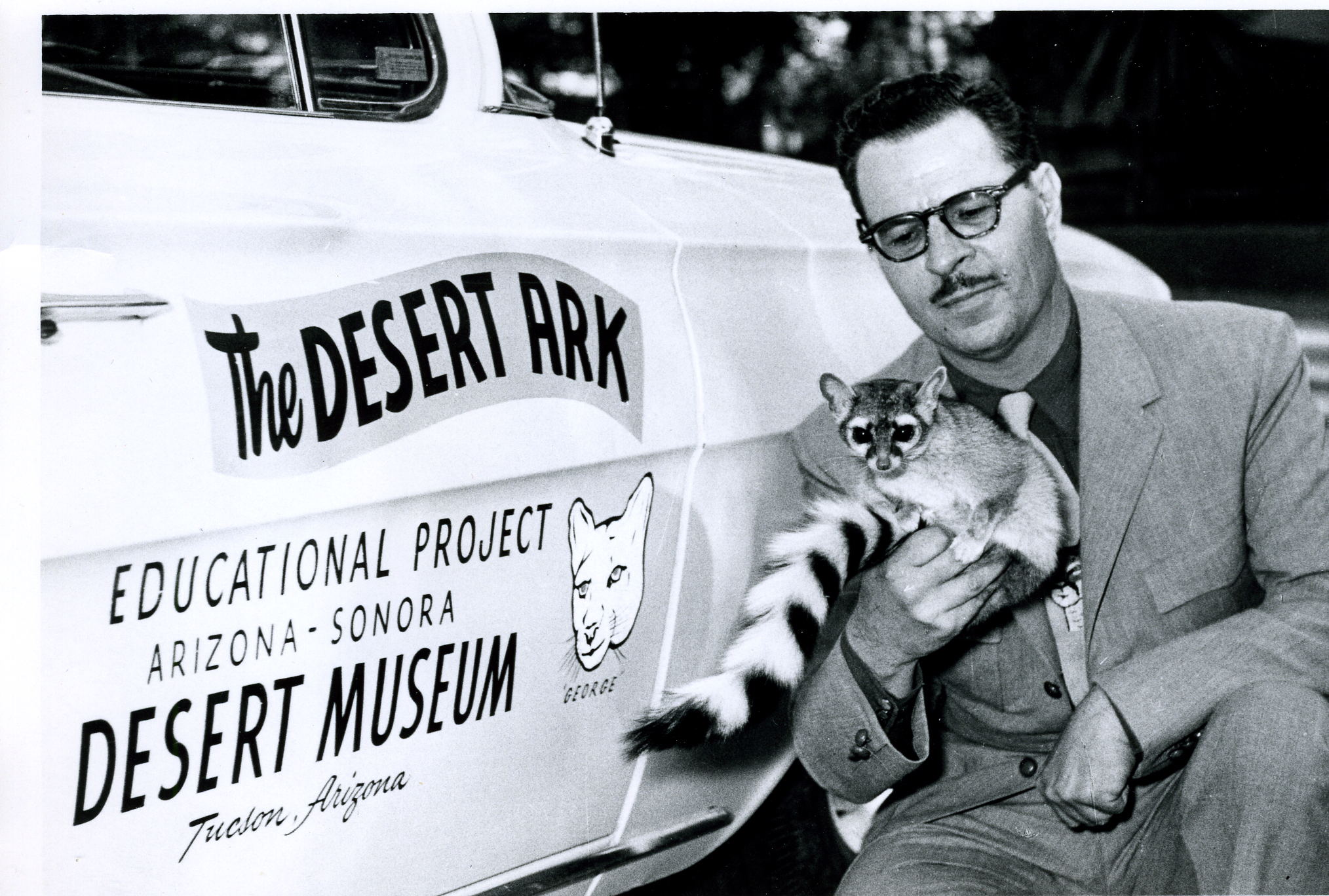
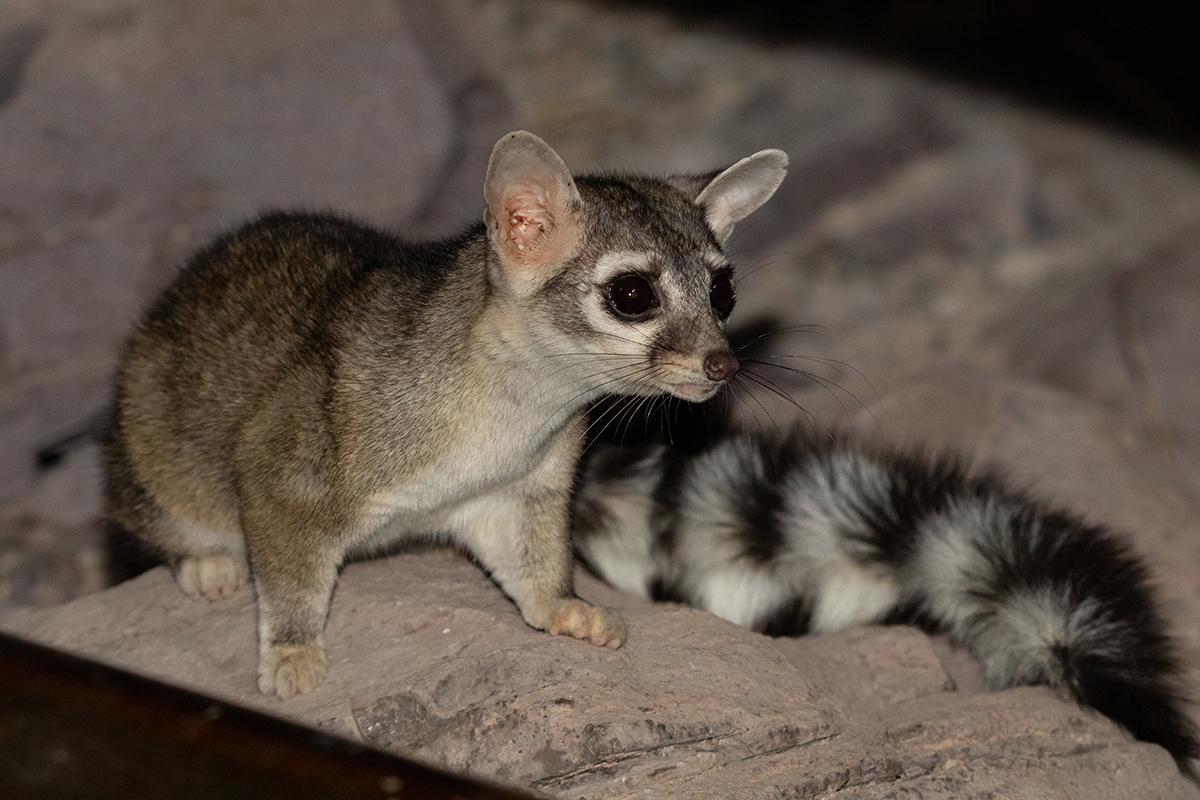
The cutest critter you never did see! Ringtails are small nocturnal mammals that are closely related to raccoons and coati. Not much larger than a squirrel, these animals are grayish brown with a distinctive black and white ringed tail. They are incredible climbers and are very elusive, making it a real treat to see one in the wild!
Did you know? Ringtails played an historical role in Arizona’s mining industry as they did a wonderful job of keeping rodents and insects out of mines and cabins. This is one of the reasons why they were named Arizona’s state mammal in 1986.
Adaptations
Ringtails are impressive critters and well adapted for nocturnal life. They have large eyes and upright ears that help them sense their surroundings in low light conditions. Their black and white tail is incredibly useful for avoiding predators; they will either fluff up their tails and curl them over their head to make them look larger/more intimidating or can use the white coloration to reflect moonlight and distract the predator enough to escape.
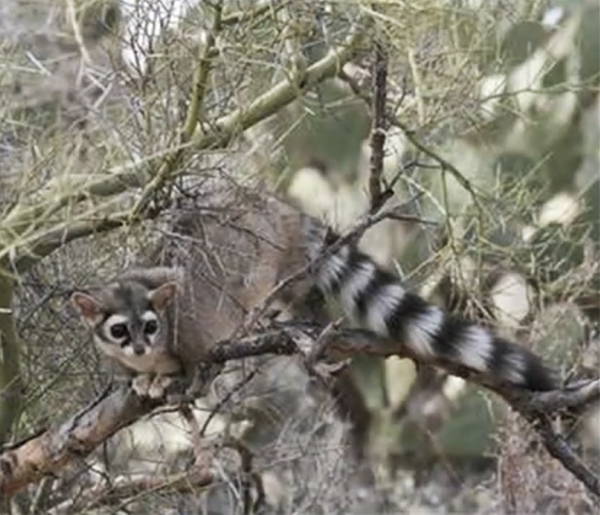
They are incredible climbers — this is particularly helpful in the rocky riparian areas where they like to live. That long, ringed tail helps them maintain balance as they climb along canyon walls. They can maneuver vertical spaces by ricocheting between surfaces or pressing all their feet against one wall and their back against the other (chimney stemming). Their back feet can rotate 180 degrees, thus allowing them to retain contact with the rocky walls upon descent.
Food Web
Ringtails are omnivorous with a strong preference for meat. They are skilled hunters that will eat just about anything that is small enough for them to catch like rodents, rabbits, insects, birds, frogs, snakes, eggs, and more! They aren’t picky and willingly eat carrion as well. As far as plants go, they typically eat fruits, nuts, or seeds.
Despite their talent for staying hidden, ringtails are not immune to predation. Common predators include great horned owls, coyotes, bobcats, and bears.
Habitat and Range
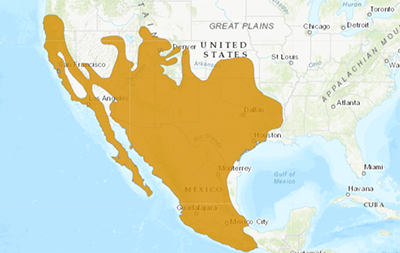
Ringtails can be found from southwestern Oregon, south through California, southern Nevada, Utah, Colorado, Texas, Arizona, New Mexico, Oklahoma, Kansas, Baja California, and northern Mexico. The ringtail prefers to live in rocky habitats associated with water. These areas can include riparian canyons, caves, and mine shafts.
Map: IUCN (International Union for Conservation of Nature) 2008. Bassariscus astutus. The IUCN Red List of Threatened Species. Version 2025-1
Family Life
Ringtails are primarily solitary as adults. They live in cozy dens in tree hollows, rock crevices, other animals’ abandoned burrows, mine shafts, abandoned buildings, or the occasional attic of a human home. The only time they meet up is mating season. Mating season is in spring, typically lasting from February through May. Ringtails will use vocalizations and scent marking to communicate with one another. Females typically have one to four offspring in May or June that need parental care before they can go off on their own. The female ringtail does most of the foraging and care, but males may occasionally be allowed to play with young as they mature.
Glossary
- Nocturnal:
- Asleep during the day and awake/active at night.
- Riparian:
- A habitat associated with water (i.e. wetland, river, stream, etc.)
- Omnivorous:
- An organism that eats both plant and animal material.
- Carrion:
- The decaying flesh of dead animals.
- Solitary:
- Describes an animal living primarily alone as opposed to a pair or social group.
Fun Facts
- In August 1986, the ringtail became the State Mammal of Arizona.
- Ringtails are sometimes wrongly called ringtail-cats or miner’s cats. However, they are not related to cats at all. Their closest relatives include the coati and the raccoon.
Conservation
Ringtails are listed as Least Concern by the IUCN Red List.
Challenges
Humans are one of the biggest threats facing ringtails. For a long time, humans would trap ringtails for their fur. While the fur trade has declined significantly, now the concern is habitat fragmentation and motor vehicles. As towns and cities expand, they encroach on ringtail habitat and make hunting at night more dangerous for these critters. Keep an eye out for that fuzzy black and white tail and slow down on roadways.There is still a lot to learn about ringtails! Their elusive nature makes it hard for scientists to observe all the complex behaviors and interactions that they may have in the wild.
Conservation Index
At The Museum
We do not currently have any ringtails at the Desert Museum, but wild ones are often spotted during Cool Summer Nights.
Keep an eye out when hiking at night near riparian areas in Arizona, and you might just spot one of these elusive critters!